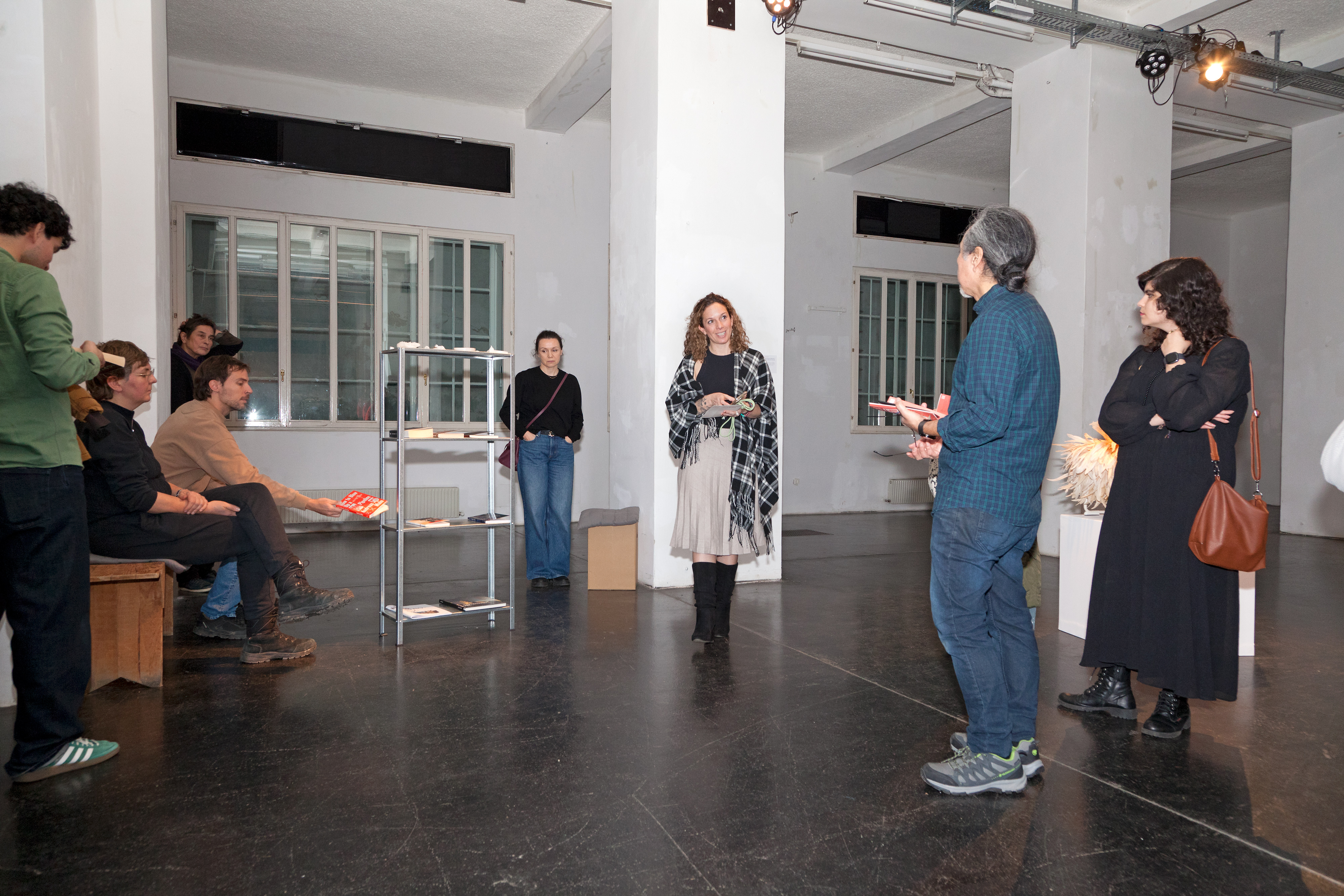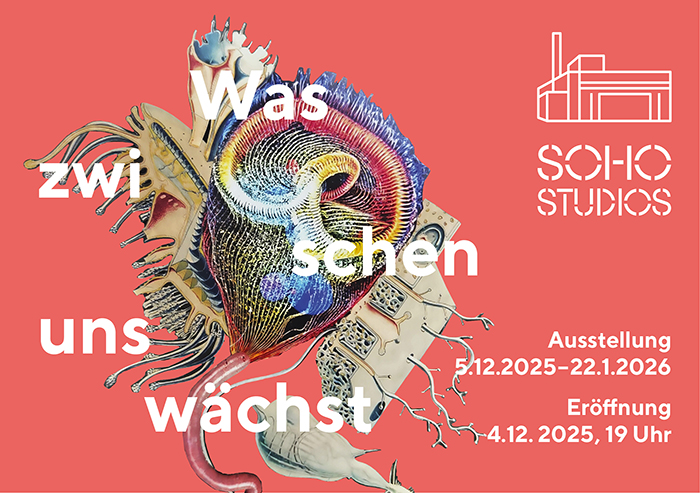
In the SOHO annual exhibition WAS ZWISCHEN UNS WÄCHST, artistic and scientific perspectives are brought together to make feminism and ecology visible as interwoven forces. The starting point is the question of how, in the midst of the climate crisis, we can develop new forms of coexistence, care, and resistance.
With: Collective AMO – Aki Namba, Mary Maggic, and Oi Pui Hoang | Lena Rosa Händle | Monica C. LoCascio | claudia* sandoval romero | Science Meets Art in artistic collaboration with Veza Czyn, Lena Gaitani, Mehrta Shirzadian, Gihan Tubbeh, as well as Camille Belmin and Sofia Gutierrez Escobar
Where: SOHO Studios, Liebknechtgasse 32, 1160 Wien
Opening: 4 December 2025, 7 p.m.
Duration: 5 December 2025 – 22 January 2026
Opening hours: Wed–Sun, 3–8 p.m.
Image credits: © Sujet: Lena Rosa Händle, Grafik: Caterina Krüger
More info on the SOHO Studios website
Side Events
- 4.12, 19:00 — Opening
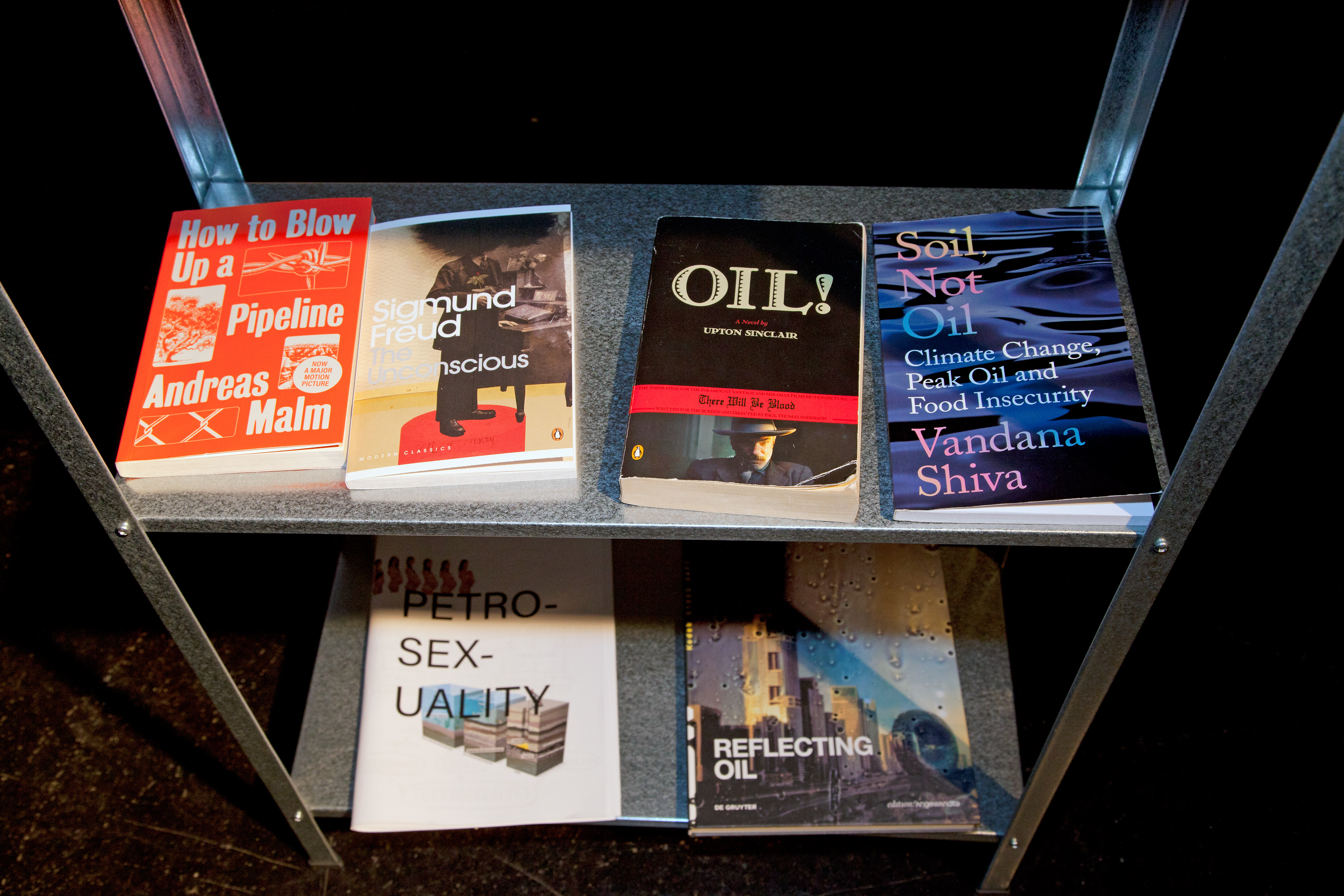
- 6.12, 17:00 — “Free Associating Oil”, reading with Veza Czyn
- 11.12, 18:30 — Artist Talk
- 13.12, 15:30 — Round with the curators
- 10.1.2026, 17:00 — “Geography of yellow walls”, performance by Mehrta Shirzadian; panel discussion
- 17.1, 17:00 — Sonic Narrative/Resistance workshop with Lena Gaitani; “flowering” participative performance with Sofia Gutierrez Escobar
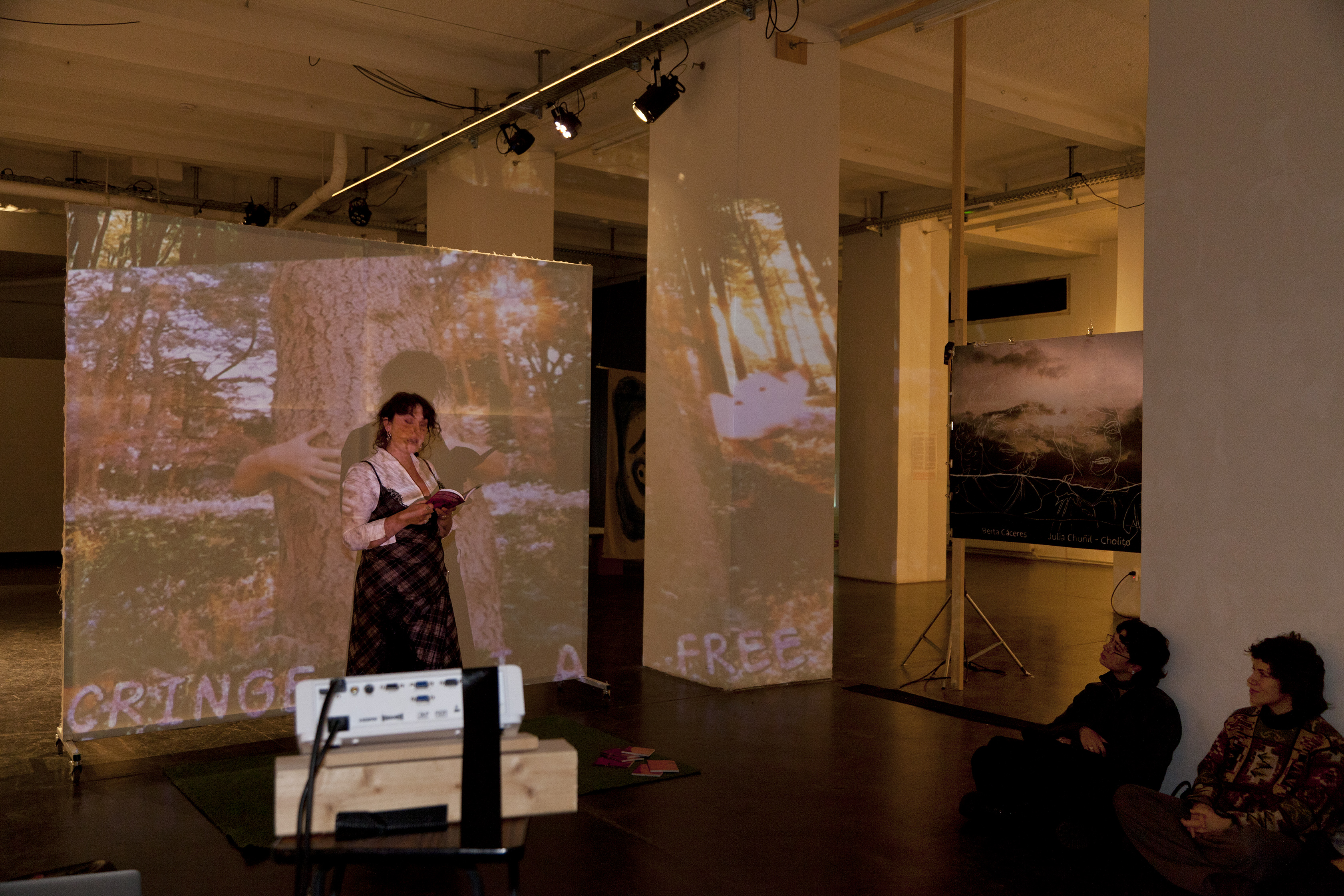
- 22.1, 18:00 — Finissage; “I am cringe but I am free” Ecoslay reading with Diana Andrei and Camille Belmin
Science Meets Art Contribution
Does climate change touch people’s lives differently through the lens of gender? How does science see this, and what can art reveal in the entanglements of power, care, and more-than-human worlds?
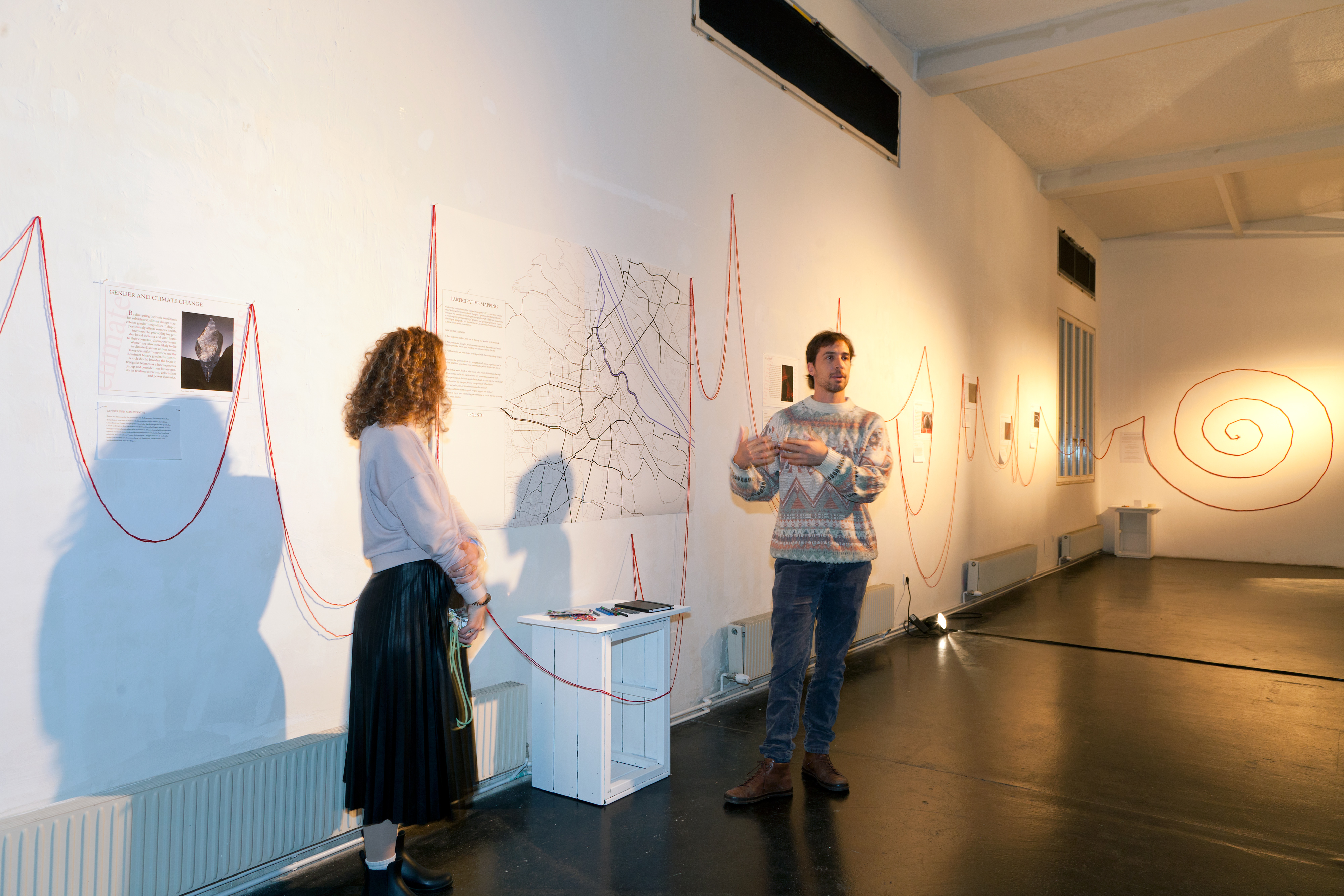
Science Meets Art brings artists and scientists into dialogue to explore these questions. Two workshops anchored the collaboration, mapping Vienna through a gender–climate lens to reveal how vulnerabilities can be embedded within space, and another envisioning collective futures beyond linear time, uncovering layered experiences of climate and gender.
This contribution interlaces insights from that process with works by five artists: Sofía Gutiérrez Escobar traces migration, memory, and care across territories; Lena Gaitani listens to the city’s rhythms of visibility; Veza Czyn, Mehrta Shirzadian, and Gihan Tubbeh explore extractivism and embodiment, opening new ways to feel, know, and imagine our shared climate futures.
Team
Camille Belmin and Sofia Gutierrez Escobar (FIA) are part of the team, and exhibit their art contribution as well.
Sofia Ballon Hamann
Sofia is an interdisciplinary and international project manager, focusing on pedagogic initiatives and cultural connections. A feminist and human rights activist, her artistic production seeks to tackle these issues. Joining Science Meets Art since its founding, she is also responsible for its steering and strategic partnerships.
Filipa Reis
Filipa Reis is a cross(in)disciplinary economist, researcher, facilitator and artist, working in topics of socio-ecological economic transformation. Their work engages with how economics can be reimagined when informed through plurality, artistic methods, embodied knowledge, and collective imagination and more equitable forms of exchange.
Adriano Vinca
Adriano Vinca is a scientist focused on climate policy, impacts, and equity considerations. He is the founder of Science Meets Art, through which he has designed and organized several projects. His artistic experience, often connected to activism and underground culture, includes experimenting with diverse media such as music, comics, and clowning.
Individual Artistic Contributions
Camille Belmin
Camille Belmin is a researcher, artist, curator, and lecturer at IIASA and independently. Her work focuses on narratives and modalities of communication that shape socio-ecological transformation, as well as population-environment-gender issues. She leads Ecoslay, an independent artistic research project that explores the boundaries of climate science communication, mobilizing the language and aesthetics of popular culture to engage diverse publics with ecological concerns. In her artistic practice, she works with installation, lecture performance and text, collaborating with metabolic processes ranging from composting and fermentation to social metabolism.
Ecoslay book reading — The Ecoslay book is a collaborative book featuring the contributions from 8 artists and researchers that introduces Ecoslay, an evolving culture that rethinks environmental communication through the lens of popular culture. Ecoslay can manifest as culture icons, influencer lifestyles, visual art and music. It is a new perspective to rethink the way we communicate ecological and social crises, with the verve of celebrity fueled hysteria. This first edition explores Ecoslay through the original pop icon — the girl, and critically explores the use of the universe of idols and hyperfeminity to engage a broader audience into environmentalism. Camille Belmin, the editor of the book, will do a performative reading of one of the chapters.
Veza Czyn
Veza Czyn is an artist, art educator and researcher based in Vienna. Her work is part research, part experiment and poetry. She works context-dependent with different material and media like drawing, installation, text, video in relation to topics like speculative fabulation, queer ecologies, ruination, outer and inner infra/structures, the aftermath of violence, concepts like the unconscious, dreams, parapraxis, repression or the uncanny. She is interested in exploring the dynamics of unconscious activity and how it shapes and structures social life.
Free Associating Oil — Free Associating Oil is the second installment of a small library of texts on petroculture. The first one was exhibited at the Klimabiennale 2025 and was called Reading Oil. As the title suggests, in this second installment a new layer of observation is added, namely a psychoanalytic one. Looking at petroculture through the lens of concepts like the unconscious, drives, dreams or desire might reveal new understandings. So, if a couch isn’t available — what better way to free associate than roaming through a library? As part of the exhibition artist Veza Czyn will do exactly this, publicly, on the 6th December at 5pm and invites visitors to join in.
Sofia Gutierrez Escobar (FIA)
Sofía Gutiérrez Escobar is a climate and feminist artivist, rooted in a peasant family history in Colombia, shaped by migration and urban realities. They have organized both local and international climate justice campaigns with art as resistance. From participating in climate policy making spaces to performing and creating visual stories, she explores collective memory, care, and radical imagination for transformation. Currently based in Austria, she is part of decolonial and grassroots collectives, and continues building bridges between communities, movements, and art for justice.
Concrete roots — How do we carry the memory and care of our territories into a city of concrete and borders? Marked by exclusion and structures that make belonging conditional. It’s the weight of displacement, the persistence of memory, and the ways in which care for the land continues across distance. Urban landscapes, the exploited river, concrete walls, anonymous streets, are juxtaposed with ancestral memory and stories of resistance. What does it mean to nurture the territory back home while inhabiting one that resists connection? Migration: a grief interwoven with care, a continuous rupture — reminding us that migration is not only movement across borders but an act of carrying memory, care, and struggle.
Lena Gaitani
Eleni Gaitani, known as Small Souki, is a musician, music therapist, and mathematician from Lamia, Greece, based in Vienna since 2015. Drawing from blues, jazz, alternative rock, psychedelic grunge, progressive metal, poetry, and spoken word, she creates immersive environments where audiences can reflect and interact. She leads Small Souki & The Big Trouble Band, producing “heroine music for socio-political troubled subjects,” and Manitari, an improvisational project incorporating audience voices and sound experimentation. Her work spans sound-art with field recordings, music therapy workshops, visual art, and contributions to choirs, opera, and youth workshops.
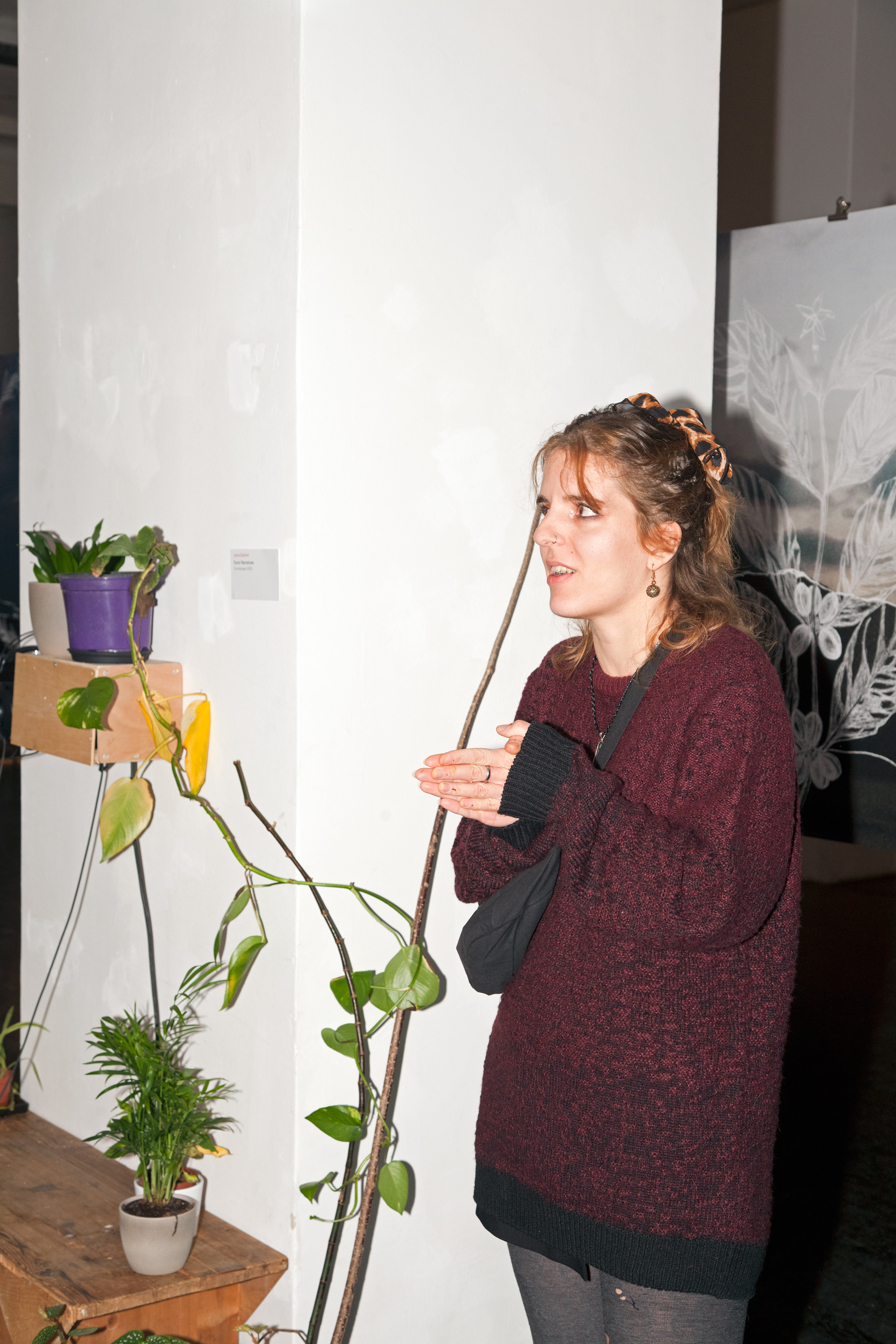
Sonic Narratives — Noise influences the communication between all living things and shapes our perception of our surroundings. In loud environments emotional responses intensify, social interaction and struggles become more difficult, often leading to imbalance and fatigue. In this series we map Vienna’s sound pressure levels and exposure to noise and explore their impact on gender equity. Through sound art and storytelling by the underrepresented people of multicultural Vienna, we explore the ways in which noise intersects with visibility, identity, and discrimination, depending on whether or not the acoustic threshold of public space is crossed.
Mehrta Shirzadian
Mehrta Shirzadian is a performer, multimedia artist and artistic researcher with a background in molecular biology, mathematics and computer science. Her work begins with the body as a site of knowledge, vulnerability and resistance. Through performance and installation she explores how anatomy is entangled with ecological and microbial systems, revealing the hidden relations between internal processes and external environments. Currently studying Art and Science at Angewandte, she creates spaces where science and poetics merge into transformative acts of care and interdependence.
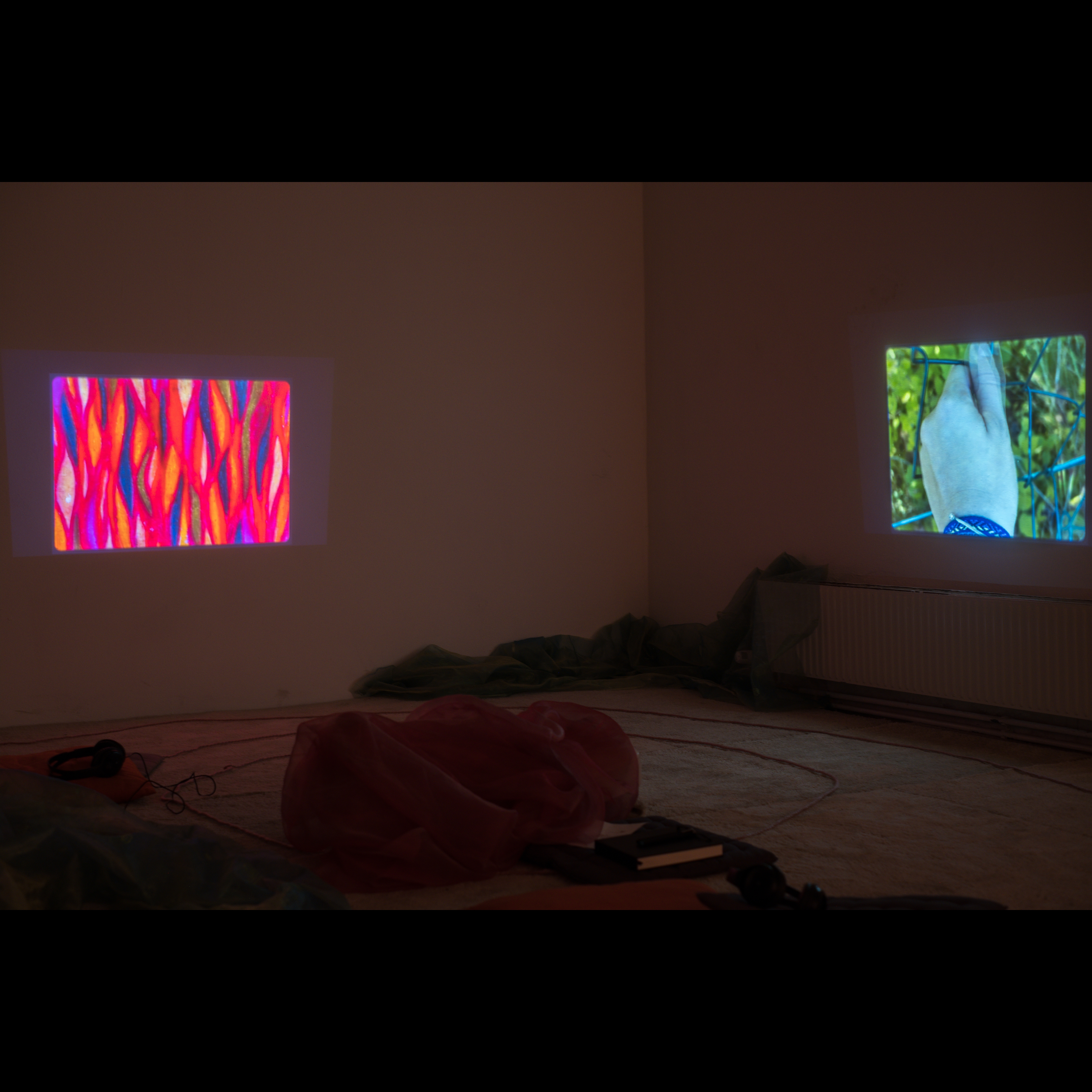
The First Soil — In this installation Mehrta Shirzadian builds a sculptural landscape out of discarded metal. The material is sharp, fractured and violent, echoing both the wounds of the climate crisis and the scars of capitalist systems that treat the earth as expendable. When light touches the jagged surfaces, the soil beneath becomes illuminated with soft shadows. Projected across these shadows are moving images of microbiomes and amoebic life — organisms that embody resilience, adaptation and care at microscopic scales. The contrast between the hardness of trash metal and the delicacy of microbial projections creates a space where violence and tenderness exist side by side.
Gihan Tubbeh
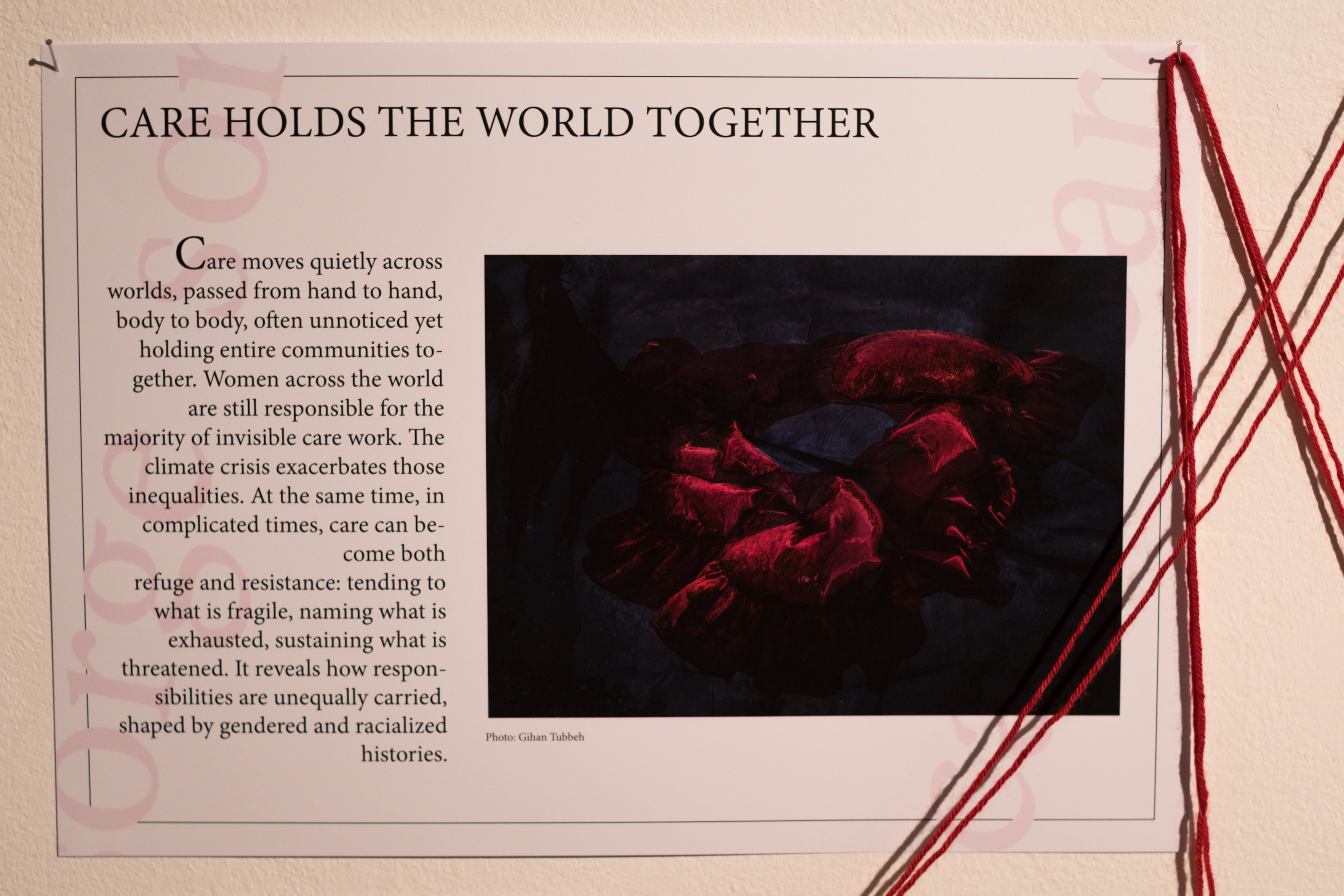
Gihan Tubbeh is a Peruvian-Palestinian photographer and visual artist working between Peru and Europe. Her practice revolves around the poetics of time in relation to territory, identity, and heritage. Tubbeh’s work resists fixed narratives, embracing ambiguity as a space of revelation. She has received international recognition, including first place at World Press Photo, Photographer of the Year at Pictures of the Year International (POY Latam), and a Magnum Foundation Grant.
Marcador de Tiempo / Time Marker — The endless thrust of extraction, where pipe and earth enact humanity’s oldest gesture: domination. Time Marker presents the repeated motion of an oil pipe, echoing humanity’s relentless cycle of extraction, reproduction, consumption, and degradation. The work reflects on petromasculinity and its historical dominance over the earth’s body, where resources are penetrated, measured, and consumed under systems of definition and control. 8mm one-channel video / 3:37min loop / 2024
De — In der SOHO-Jahres-Ausstellung WAS ZWISCHEN UNS WÄCHST werden künstlerische und wissenschaftliche Positionen zusammengebracht, die Feminismus und Ökologie als verflochtene Kräfte sichtbar machen. Ausgangspunkt ist die Frage, wie wir inmitten der Klimakrise neue Formen des Zusammenlebens, der Fürsorge und des Widerstands entwickeln können.
Mit: Kollektiv AMO – Aki Namba, Mary Maggic, and Oi Pui Hoang | Lena Rosa Händle | Monica C. LoCascio | claudia sandoval romero | Science Meets Art in künstlerischer Zusammenarbeit mit Veza Czyn, Lena Gaitani, Mehrta Shirzadian, Gihan Tubbeh, sowie Camille Belmin und Sofia Gutierrez Escobar*
Ort: SOHO STUDIOS, Liebknechtgasse 32, 1160 Wien — Eröffnung: 4.12. 2025, ab 19 Uhr im Kongresspark mit Kollektiv AMO — Dauer: 5.12. 2025 – 22.1. 2026 — Öffnungszeiten: Mi-So, jeweils 15-20 Uhr
© Sujet: Lena Rosa Händle, Grafik: Caterina Krüger
Gallery